Grief doesn't follow a schedule. It shows up at the grocery store, in the car, on a Tuesday afternoon when nothing in particular triggered it. The people who are grieving know this already. And the people who love them — the ones searching for a sympathy gift or a memorial keepsake — often feel helpless because no gift can fix what's been lost.
That's true. No gift can. But the right gift can offer something smaller and more honest: a way to carry the person who's gone. Not on a shelf or in a box, but with them — through the ordinary days when the absence is sharpest.
This isn't a sales pitch. It's a guide for anyone navigating the difficult question of how to honor someone's memory in a way that genuinely helps.
What grief actually needs
When someone loses a person they love, the world keeps moving and they don't. The casseroles stop arriving after a week. The calls taper off after a month. The sympathy cards get put in a drawer. And the person left behind is still sitting with the loss, often in silence, because grief makes people uncomfortable and most people stop asking.
The memorial gifts that help most aren't the ones that arrive in the first week. They're the ones that show up in month three, or month six, or on the first anniversary — when everyone else has moved on and the grief hasn't. And they help not by being grand, but by being present. Something small, something physical, something that says "I know you're still carrying this, and I see you."
The comfort of carrying their words
One of the cruelest things about loss is how quickly the tangible things fade. The sound of their voice gets harder to recall. The specific way they said your name starts to blur. The texts get buried. The voicemails, if they were saved, live on a phone that will eventually be replaced.
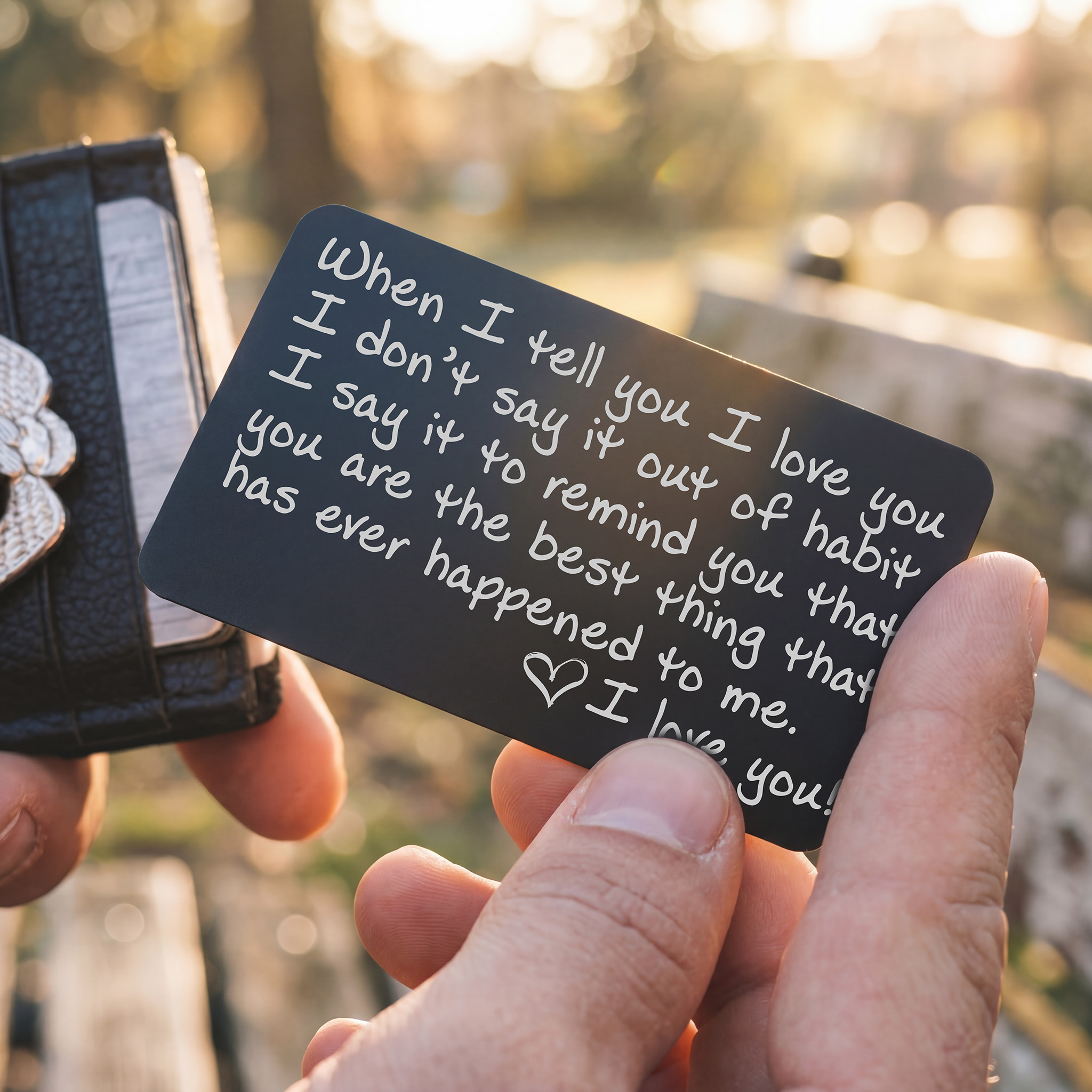
A memorial wallet card preserves one thing permanently: their words. Maybe it's something they always said — a catchphrase, an endearment, the way they signed every card. Maybe it's the last thing they texted. Maybe it's a line from a letter they wrote years ago. Whatever it is, putting it on a wallet card means it's laser-engraved on metal and carried in a wallet — not stored, not filed away, but present. Every day.
"My dad used to say 'You're tougher than you think, kid' every time something went wrong. After he passed, my mom had it engraved on a wallet card for me. I carry it everywhere. Some days it's the only thing that gets me through."
— Ryan M.The photo wallet card option
For some people, the most meaningful memorial isn't words — it's handwriting. If you have a note, a card, a signature, or anything written by the person who's gone, a photo wallet card can preserve it. You send a photo of the handwriting, and it gets engraved directly onto the card — their actual penmanship, permanently rendered in metal.
This option also works for photos themselves. A portrait, a candid shot from a good day, a moment you want to carry. The photo wallet card turns a digital image into something physical and permanent — something that lives in a wallet instead of a camera roll.
We mention this not as an upsell but because many people don't know it's possible. The ability to carry someone's actual handwriting — the loops, the slant, the imperfections that made it theirs — is something people tell us means more than they expected.
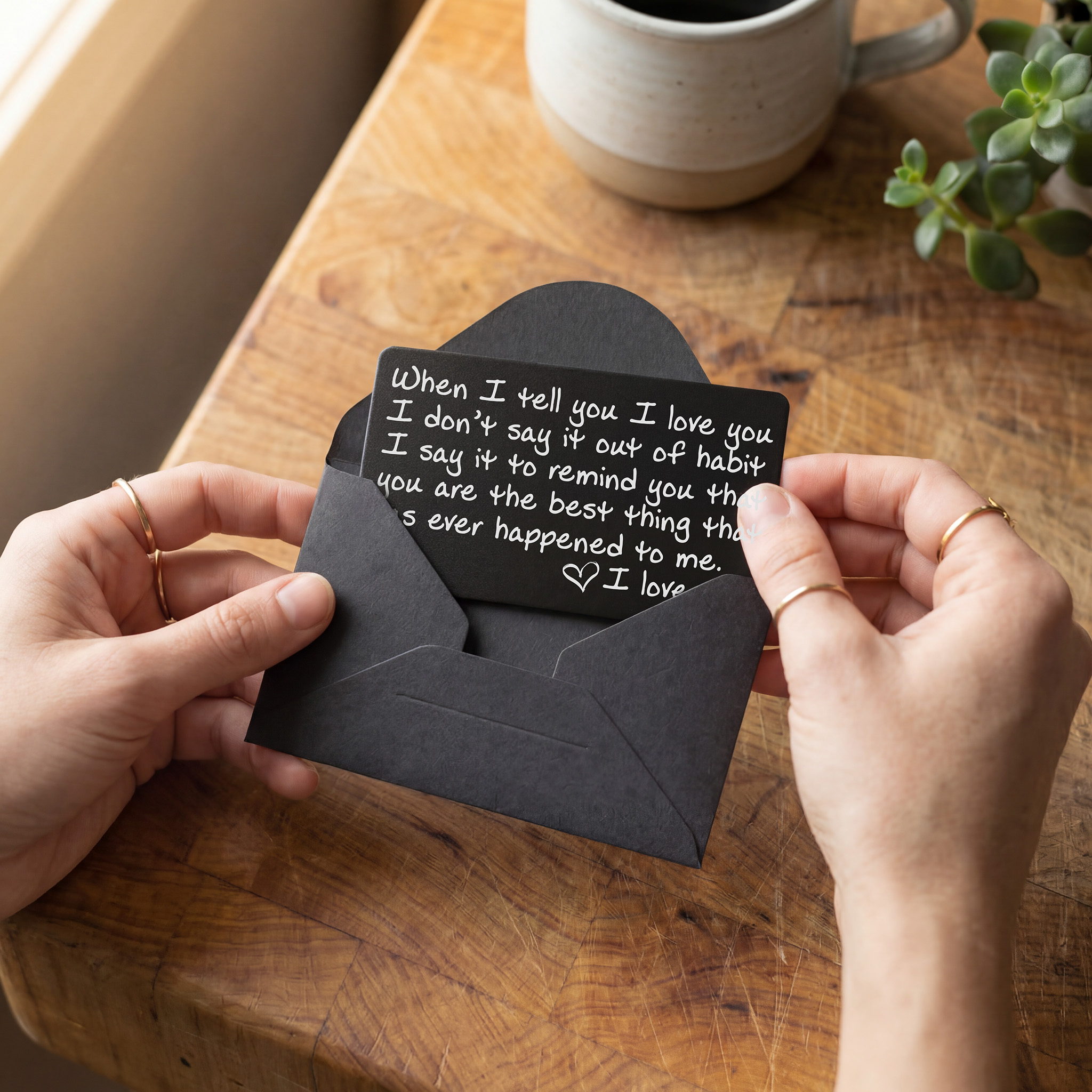
Photo Wallet Card
Their handwriting, their photo, or a meaningful image — permanently engraved on metal. Carried every day, close to the heart.
See the Photo CardWhat to put on a memorial wallet card
There's no formula for this. Grief is personal, and so is the message. But here are some directions that have brought comfort to the people who carry these cards:
- Their favorite saying: The thing they repeated so often it became part of your family's vocabulary. Hearing it in your head is one thing. Seeing it engraved and carrying it is another.
- Their last words to you: If the last conversation was a good one — "I love you," "I'm proud of you," "Take care of your mother" — preserving those exact words can be profoundly grounding.
- A line from something they wrote: A birthday card, a letter, an email. Most people keep these in a drawer. Putting the most important line on a wallet card means it travels with you.
- Their handwriting: Via the photo card option. Their signature, a note, a doodle — anything in their hand.
- Your words to them: "I carry you with me. Every day. — Your [son/daughter/wife/husband]." Sometimes the memorial isn't about their words. It's about yours — the thing you still want to say.
Giving a memorial gift with care
Timing matters with memorial gifts, and "sooner" isn't always better. In the first days after a loss, people are overwhelmed — by logistics, by visitors, by the sheer volume of feeling. A meaningful keepsake can get lost in the noise.
Consider giving a memorial wallet card at one of these moments instead:
- A few weeks after the funeral, when the house is quiet and the support has thinned
- On the first birthday or anniversary after the loss
- On the one-year mark — a reminder that you remember too
- On a holiday they always spent together — Thanksgiving, Christmas, Father's Day
When you give it, keep it simple. You don't need a speech. "I thought you might want to carry this" is enough. The card speaks for itself.
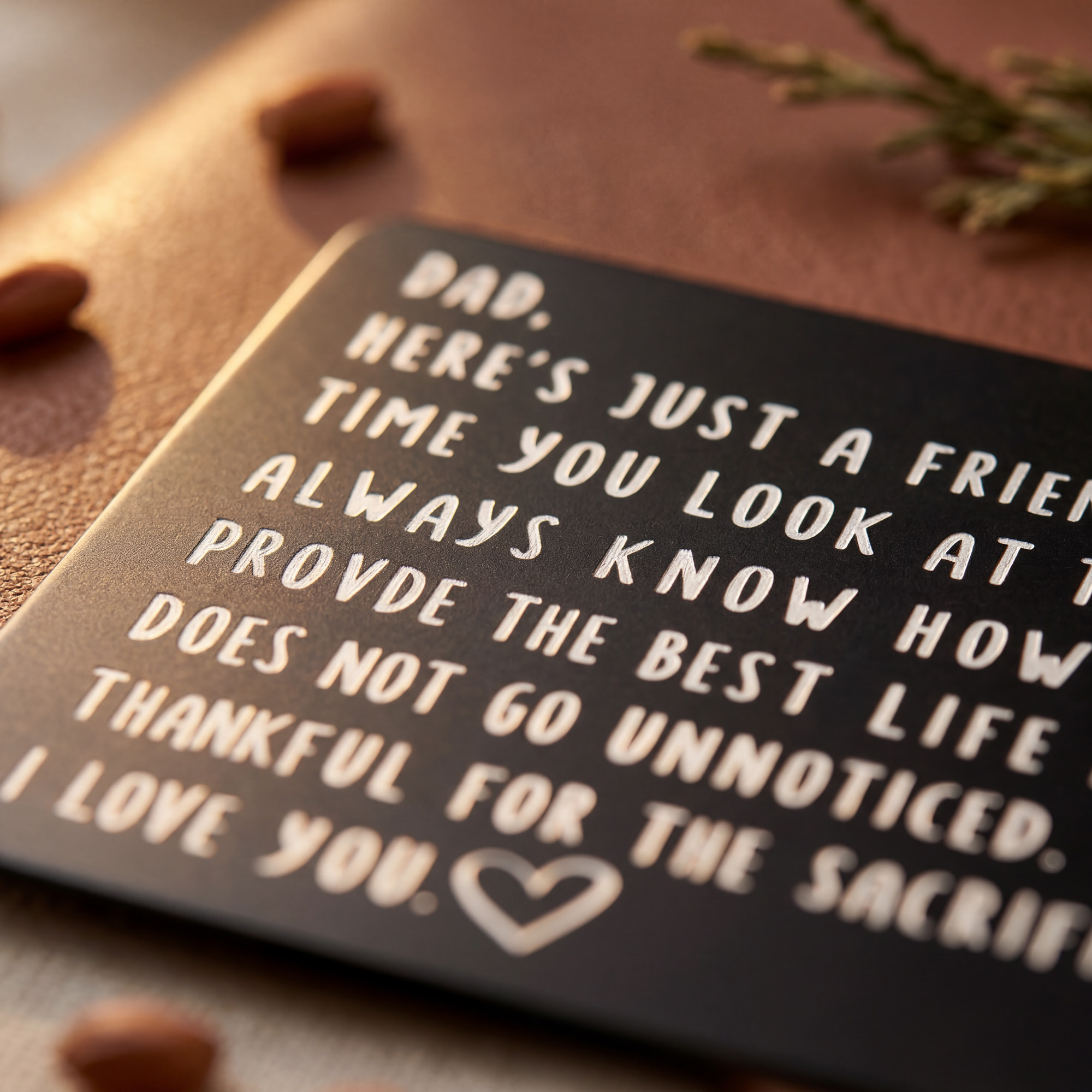
Laser-engraved on metal. Carried every day. A quiet way to keep them close.
For the person buying this for themselves
Not every memorial wallet card is a gift from someone else. Some people order their own — for a parent they lost, a spouse, a child, a friend. If that's you, know that there's nothing strange or indulgent about it. Wanting to carry something physical that connects you to someone you've lost is one of the most human impulses there is. A wallet card just makes it portable and permanent.
Grief doesn't end. But it changes. And having something physical to hold onto — something that carries their words or their image or your message to them — can make the weight of it slightly more bearable. Not fixed. Not gone. But bearable. And some days, that's enough.