"Laser engraved" shows up on everything now. Tumblers, cutting boards, phone cases, keychains, dog tags, flasks. The phrase has become shorthand for "personalized" —but most people buying laser engraved gifts have no idea what actually happens during the process, what kind of laser was used, or whether the result will last six months or sixty years.
That distinction matters. The type of laser, the material it hits, and the method used to mark the surface all determine whether you're buying something permanent or something that fades, scratches, or peels within a year. If you're spending money on a gift that's supposed to mean something —an engraved love note, a message to carry every day —the details are worth understanding.
Here's what we've learned from years of running a laser engraving operation, and what you should know before you buy.
The Three Types of Laser Engraving (And Why It Matters)
Not all lasers do the same thing. There are three main types used in the engraving world, and each one works differently on different materials. The distinction isn't just technical trivia —it directly affects the quality and longevity of the finished product.
CO2 Lasers
CO2 lasers use a gas mixture (carbon dioxide, nitrogen, hydrogen, helium) to generate a beam in the infrared spectrum. They're the workhorse of the engraving industry —versatile, precise, and excellent on organic materials like wood, leather, acrylic, and paper. They also work beautifully on anodized metals, which is what we use for our wallet cards.
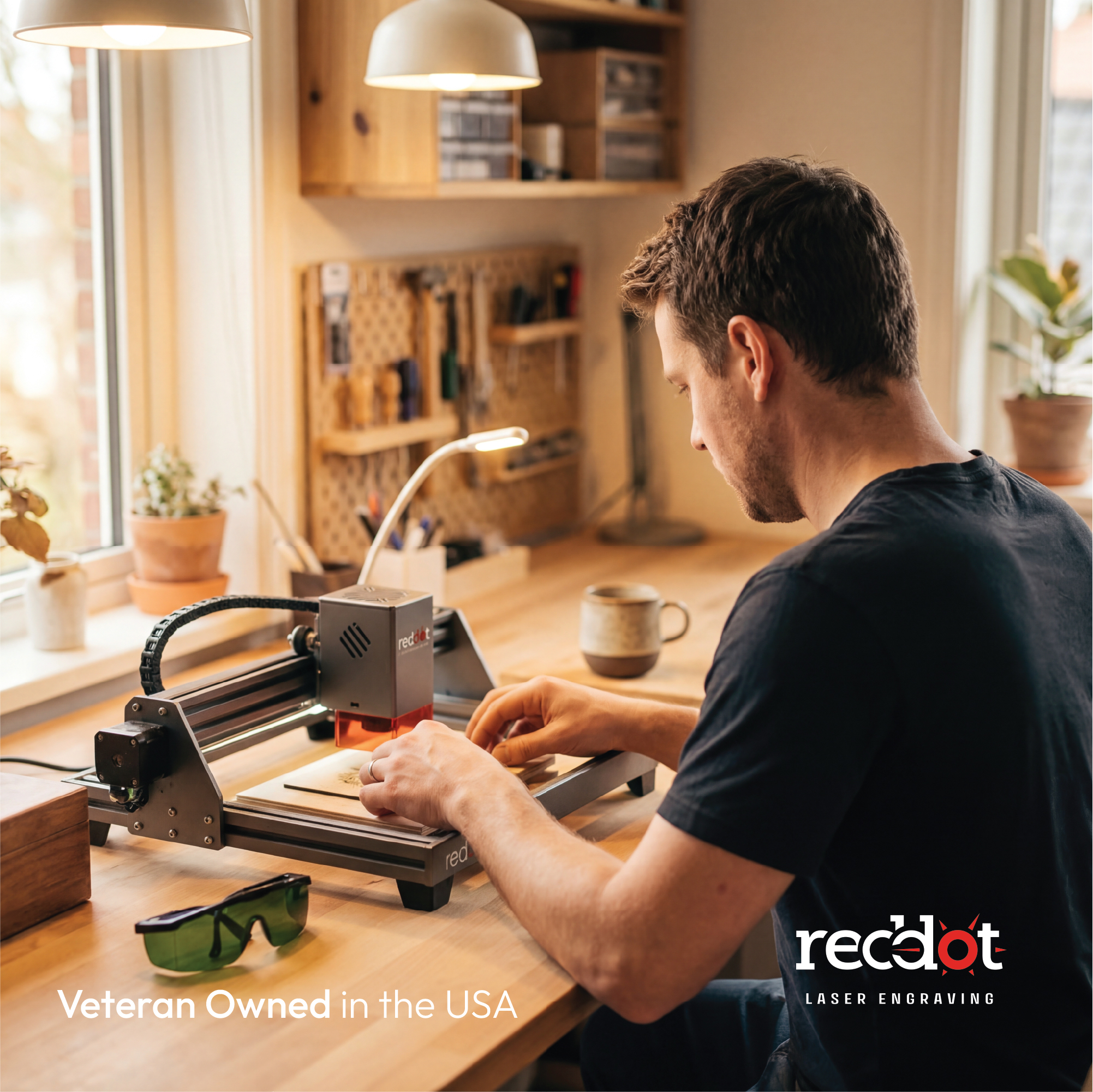
The key advantage of a CO2 laser is control. You can dial in exact power levels and speeds to remove material at precise depths. On anodized aluminum, the laser selectively removes the anodization layer to reveal the raw aluminum underneath, creating a permanent contrast that can't be rubbed off or washed away. This is the type of laser we use —an Aeon MIRA7 60W —and it's the reason our cards look the way they do.
Fiber Lasers
Fiber lasers operate at a different wavelength and are designed primarily for marking raw metals —stainless steel, titanium, brass, copper. They're common in industrial manufacturing, medical device marking, and jewelry. Fiber lasers can etch directly into bare metal surfaces that a CO2 laser would just bounce off of. They're powerful, precise, and expensive.
If you see laser engraved gifts made from raw stainless steel or titanium with a visible mark in the metal itself, that was almost certainly done with a fiber laser. The results can be excellent, but the machines cost two to five times more than a comparable CO2 setup, which is why you see them more in industrial settings than small shops.
Diode Lasers
Diode lasers are the entry-level option. They're the ones you see on hobbyist YouTube channels and Amazon for a few hundred dollars. They work —sort of. A diode laser can burn designs into wood, engrave leather lightly, and mark certain coated surfaces. But they're significantly less powerful than CO2 or fiber lasers, which means shallower marks, slower speeds, and less consistency.
The gift products coming off diode lasers tend to be lighter engravings that can wear faster. That's not a knock on hobbyists doing good work —some do. But when you're evaluating laser engraved gifts online, the difference between a product made on a $300 diode laser and one made on a $12,000 CO2 laser is real, even if the listing photos look similar.
What Can Be Laser Engraved?
The short answer: a lot more than most people think. The slightly longer answer: it depends entirely on which laser you're using.
With a CO2 laser like ours, the best results come from:
- Anodized aluminum —This is what our wallet cards are made from. The laser removes the anodized layer cleanly, leaving bright aluminum text against a dark background. Extremely durable and permanent.
- Wood —Plywood, hardwoods, bamboo. The laser burns away material to create depth and contrast. Results vary by wood type and grain.
- Leather —Real leather engraves beautifully. The laser darkens the surface rather than removing material, creating a branded or burned look.
- Acrylic —Both clear and colored acrylics engrave well. The laser creates a frosted white mark that catches light.
- Glass —The laser fractures the surface in a controlled way. Good for decorative pieces, though the mark is more subtle than on opaque materials.
- Coated metals —Powder-coated tumblers, painted metal surfaces. The laser removes the coating to reveal the metal beneath.
- Stone —Granite, marble, slate. Works well for plaques and memorials, though it requires higher power settings.
What doesn't engrave well with a CO2 laser: bare chrome, raw stainless steel (you'd need a fiber laser or a marking compound), most plastics with PVC content (releases toxic chlorine gas), and anything highly reflective without a coating. If a seller is vague about what material they're engraving on, that's worth asking about.
How Long Does Laser Engraving Last?
This is the question that matters most when you're buying a gift, and the answer depends entirely on method and material. There are three broad categories of "personalized" products, and they're not equal:
Printed —UV printing, inkjet, sublimation. The image or text sits on top of the surface. It can look sharp initially, but it's vulnerable to scratching, UV fading, and wear. Most printed personalization degrades visibly within one to three years of regular handling.
Etched —Chemical or light etching that alters the surface but doesn't remove significant material. Better than printing, but still relatively shallow. Etched marks can fade or become less visible over time, especially on surfaces that see daily friction.
Engraved —Material is physically removed by the laser. On anodized aluminum, the anodization layer is gone where the laser hit. That mark isn't sitting on the surface —it is the surface. There's nothing to fade, peel, or wash away. The contrast between the dark anodized layer and the bright aluminum beneath is permanent because it's a structural change in the material, not a coating.
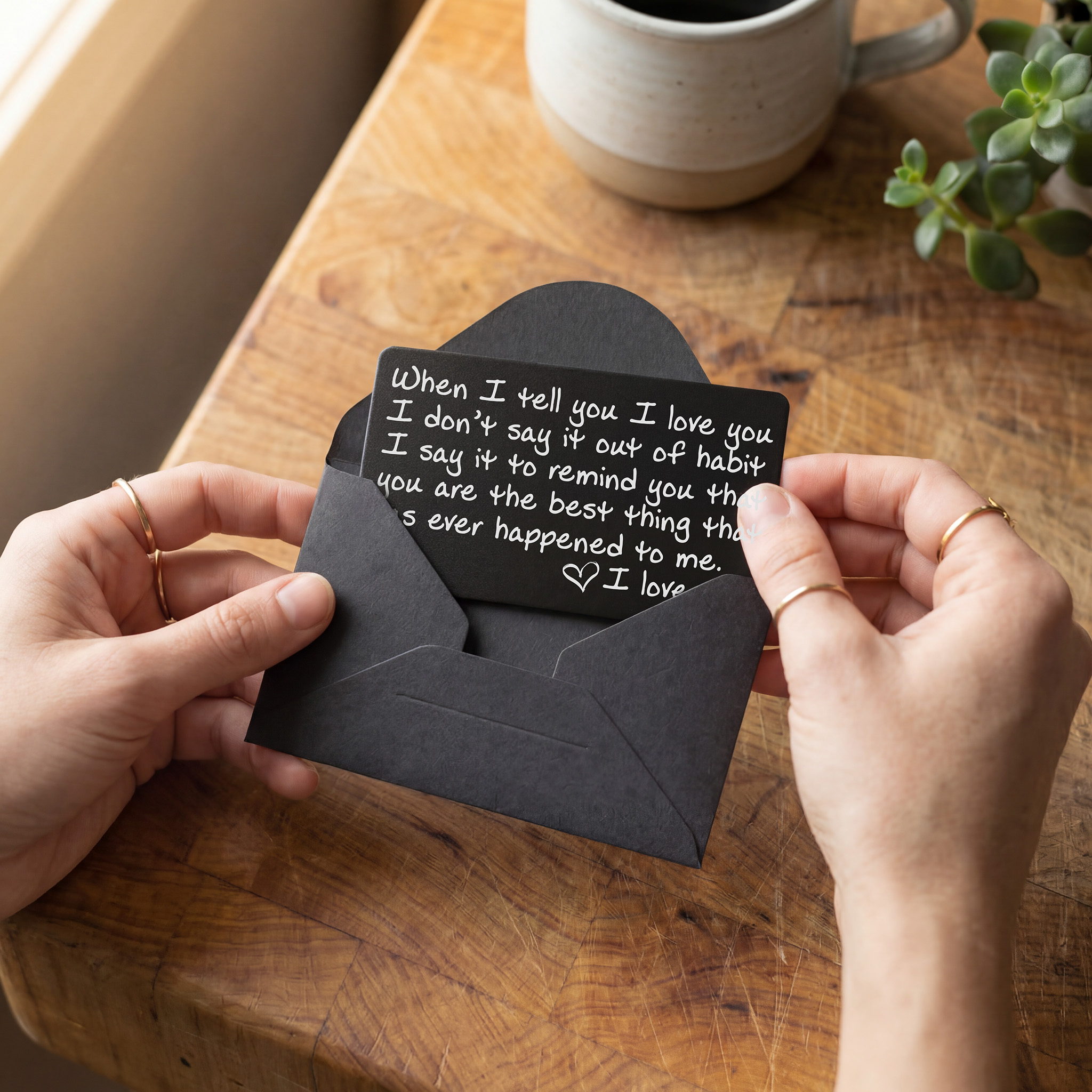
Our wallet cards fall into that third category. The engraving is the metal itself. We've had customers tell us their cards have gone through washing machines, spent years in wallets being sat on and shuffled around, and the engraving looks exactly the same as the day it arrived.
"I've had my wallet card for three years. Put it through the wash twice. Still looks exactly the same."
-- Mark R., verified buyerThat's not because we found some magic coating. It's because the engraving process itself produces a result that can't degrade under normal conditions. The aluminum isn't going anywhere. The contrast isn't going anywhere. The only way to remove a laser engraving from anodized aluminum is to physically sand through the metal —and at that point, you've destroyed the card.
How We Make Our Cards
We run an Aeon MIRA7 —a 60-watt CO2 laser made by Aeon Laser USA. It's not the cheapest machine you can buy, and it's not the most expensive. It's the one that produces the results we need at the precision level our cards require.
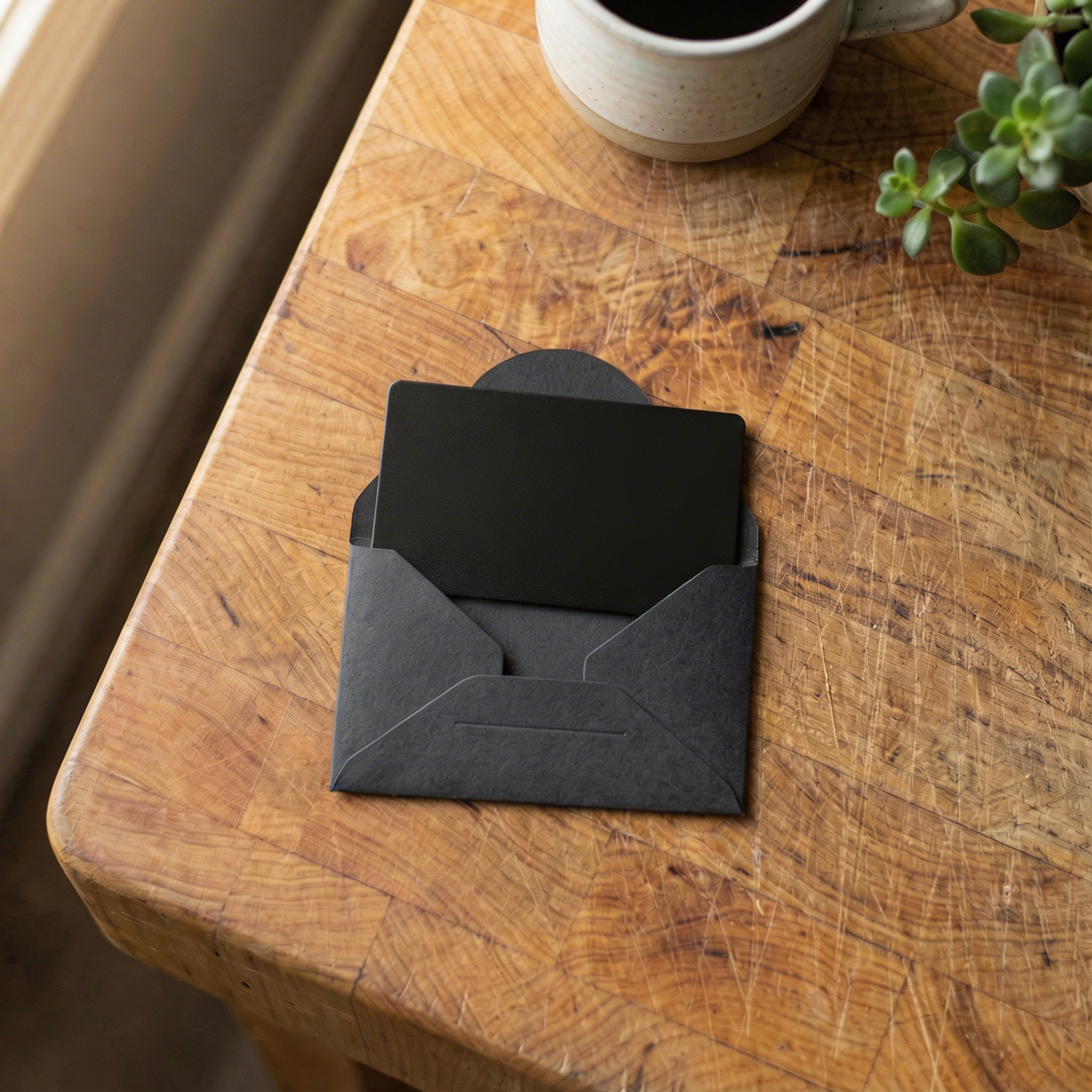
The process starts with anodized aluminum blanks cut to credit-card size. The anodization is the black layer on the surface —it's hard, scratch-resistant, and creates the dark background that makes the engraved text pop. When the laser fires, it vaporizes the anodization in exactly the areas where text and design should appear, revealing the raw silver aluminum underneath.
The reason CO2 works so well on anodized aluminum specifically is the wavelength. CO2 lasers operate at 10.6 microns in the far infrared range. Anodized coatings absorb that wavelength efficiently, which means clean removal with minimal heat spread to surrounding areas. The result is sharp edges on every letter —no blurring, no halo effect, no rough transitions between the marked and unmarked areas.
Each card is engraved individually. We're not running batch prints or stamping from a die. Every card goes through the laser one at a time, gets inspected for alignment and clarity, and ships in a gift-ready box. If something doesn't look right —a letter that didn't mark evenly, spacing that's off by a hair —it gets redone. The process takes longer than mass production, but that's the trade-off for the kind of detail you notice when you're holding the card six inches from your face. And that's exactly where wallet cards end up.
If you want the full step-by-step breakdown, we wrote a separate piece on how a wallet card gets made that walks through every stage from blank to box.
What to Look For When Buying Laser Engraved Gifts
Not every listing that says "laser engraved" delivers the same quality. Here's what to pay attention to when you're shopping —whether it's from us or anyone else.
Material matters more than the design. A beautiful font on cheap material is still a cheap gift. Look for listings that specify exactly what the product is made from. "Metal" is vague. "Anodized aluminum" or "stainless steel" tells you something. If a seller won't name the material, that's a red flag.
Engraving depth determines durability. Shallow engraving looks fine in a product photo but can become less visible over time, especially on surfaces that see daily contact. True laser engraving removes material —it should be visible and tactile. If a listing describes the process as "laser printed," that's a different thing entirely. Laser printing uses a toner or marking compound that sits on the surface. It's not the same as engraving.
UV resistance and water resistance. If the gift is going to live in a wallet, pocket, or anywhere it'll see daylight and moisture, ask whether the mark is UV-stable. Engraved marks on anodized aluminum are inherently UV-stable because there's no ink or coating to fade. Printed or sublimated marks are not.
Watch for ultra-cheap prices. A "laser engraved" wallet card for $3.99 is almost certainly made from thin aluminum or tin with a printed or lightly etched surface. The material cost alone for quality anodized aluminum blanks makes that price point impossible for real engraving. You don't need to spend a fortune, but if a price seems too low for a metal product with personalization, it probably is.
Personalization options. Some sellers offer truly custom text —your words, your message. Others offer pre-written messages that have been tested and refined for specific occasions. Both are valid. The difference is whether you want to write the engraved love note yourself or trust someone who's written a few thousand of them. We offer both.
Why a Wallet Card Is the Best Laser Engraved Gift
We're biased, obviously. But the logic holds up even if you set the bias aside.
Most sentimental gifts for men fall into one of two categories: decorative or functional. Decorative gifts —plaques, picture frames, display pieces —look great for a while and then blend into the background. They become part of the scenery. You stop seeing them.
Functional gifts are different. A wallet card lives in his wallet, which means it's with him every day. He doesn't have to display it or find a place for it. It just exists alongside the things he already carries —his license, his bank card, the stuff he pats his pocket to check for. It becomes part of the daily routine without requiring any effort or intention.
That's what makes it different from engraved gifts for him that end up on a shelf. A wallet card doesn't ask for attention. It just shows up when he's reaching for his credit card at the gas station, or emptying his pockets at the end of a long day. The message is there. It doesn't need a mantle or a hook on the wall.
It's also small, which sounds like a minor thing but isn't. The portability means it goes everywhere —work, travel, the gym, the grocery store. A gift that's physically present in someone's daily life has a different kind of weight than one that stays in one room of the house.
And because it's laser engraved on anodized aluminum, it doesn't degrade. The card he pulls out in five years looks the same as the one you gave him. That's not sentimentality —it's material science.
Ready to Find the Right Card?
If you already know what you want to say, our pre-written cards on Etsy cover the messages that matter most —for husbands, dads, sons, and the people who are hard to shop for. If you want to write your own words and have them engraved exactly as you send them, our Etsy shop handles full custom personalization.
Either way, the result is the same: a card engraved on metal, built to outlast the wallet it rides in, carrying a message that means something. No printing, no coating, no shortcuts. Just a laser, good material, and words worth keeping.